

Healthcare is one of those fields that looks simple until you start looking closely.
A patient walks into a clinic, talks to a healthcare professional, gets a test, receives treatment, and goes home. That sounds straightforward. Behind that one visit, however, there may be doctors, nurses, technicians, pharmacists, administrators, information systems, laboratories, insurance processes, patient records, and technology working together.
That is why starting with random medical terms or jumping directly into an advanced healthcare course can be confusing.
If you want to start healthcare the right way, begin with the system itself.
Learn who is involved, how a patient’s journey works, where information moves, how technology supports healthcare, and what different career paths actually look like. Once you understand those connections, specialized topics become much easier to learn.
This Healthcare Beginner Guide is designed for students, beginners, career explorers, and technology learners who want to understand healthcare before choosing a specialization.
What You’ll Be Able to Understand After Reading This Guide
By the end of this guide, you’ll be able to:
- Explain what a healthcare system includes
- Follow a basic patient journey from appointment to follow-up
- Understand common healthcare terminology
- Distinguish clinical and non-clinical healthcare roles
- Explain what EHRs and other healthcare information systems do
- Understand why healthcare data, privacy, and security matter
- Identify the connection between healthcare and technology
- Explore healthcare career paths based on your interests
- Create a practical starting roadmap for your own learning
The bigger goal is simple: you should finish knowing what to learn next and why.
What Is Healthcare?
Healthcare isn’t simply the treatment a patient receives when they become sick.
It includes the people, organizations, resources, services, information, and processes involved in promoting, maintaining, and improving health.
The World Health Organization describes a health system in similarly broad terms, including the organizations, people, and resources involved in improving health.
That broader definition changes the way you should think about the field.
A hospital is part of healthcare. So is a diagnostic laboratory.
A nurse is part of healthcare. So is a health information specialist.
A medical device can be part of healthcare. So can the software used to manage the information generated by that device.
This leads to an important idea for beginners:
Healthcare is an ecosystem, not a single profession.
Once you see healthcare as an ecosystem, many career options that initially seem unrelated begin to make sense.
The Easiest Way to Understand Healthcare: Follow the Patient
Instead of memorizing a long list of healthcare terms, start with one patient.
Imagine that Sarah has been experiencing persistent fatigue.
She books an appointment with a healthcare provider.
During the visit, information about her symptoms and medical history is collected. The provider may decide that laboratory testing is appropriate. The test is performed, the results are recorded, and the provider reviews them alongside other relevant information.
Depending on the situation, Sarah may receive treatment, medication, additional testing, or a referral.
Later, someone may need to review her records during a follow-up appointment.
Now look at what happened:
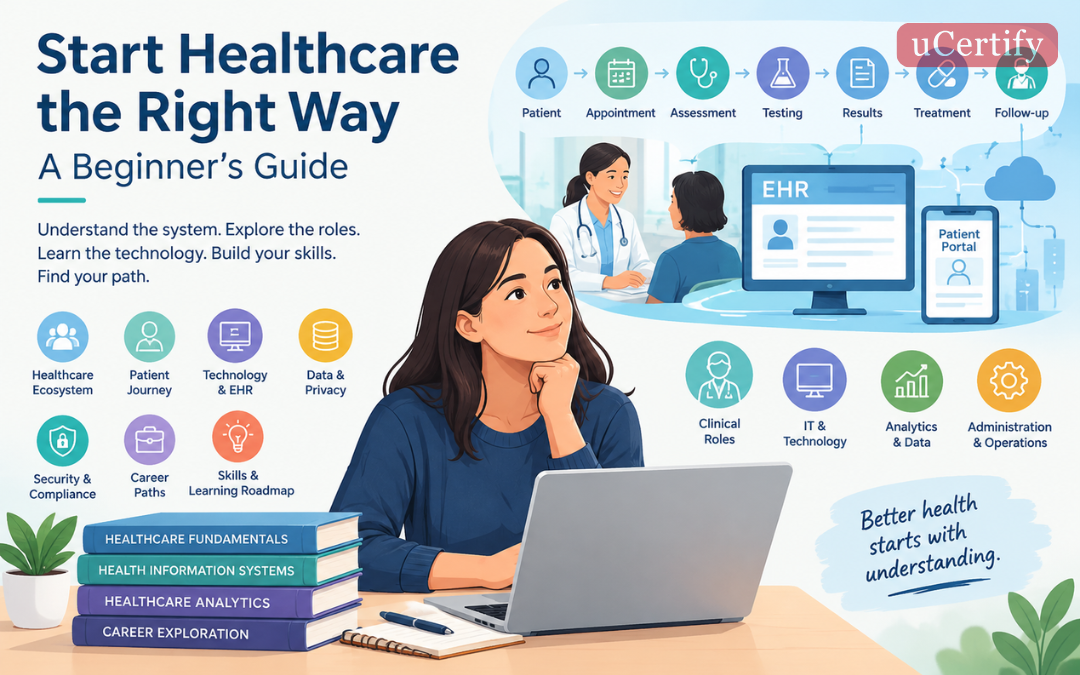
Patient → Appointment → Assessment → Testing → Results → Decision → Treatment → Follow-up
That sequence is more useful than a page of isolated definitions because it shows how different parts of healthcare connect.
And there is another layer underneath it.
Information has to be recorded.
People need appropriate access to that information.
Tests have to be processed.
Results have to reach the right people.
Appointments need to be coordinated.
Payments and administrative processes may also be involved.
Technology often connects several of these activities.
This is the mental model beginners should build first.
Who Is Involved in Healthcare?
Once you understand the patient journey, the different roles become easier to place.
Clinical Professionals
Clinical professionals are involved directly in patient care or clinical services.
Depending on the healthcare setting, this can include:
- Physicians
- Nurses
- Pharmacists
- Physical therapists
- Occupational therapists
- Respiratory therapists
- Radiologic technologists
- Medical laboratory professionals
These careers usually involve specialized education and professional requirements that vary by occupation and location.
Non-Clinical Professionals
Not everyone working in healthcare provides direct patient care.
Healthcare organizations also need people working in areas such as:
- Healthcare administration
- Health information management
- Medical coding
- Healthcare IT
- Data analytics
- Project management
- Operations
- Billing and revenue processes
- Health informatics
This distinction matters if you’re deciding where to begin.
Someone who enjoys patient interaction may prefer a clinical pathway.
Someone who enjoys computers and systems might find healthcare IT more interesting.
Someone who likes data may want to explore healthcare analytics or informatics.
Someone who enjoys organization and leadership might investigate healthcare administration.
You don’t have to choose immediately. First understand what each area actually involves.
Learn Healthcare Vocabulary Through Context
Medical terminology can be intimidating at first.
The problem isn’t necessarily that the words are difficult. It’s that beginners often encounter dozens of them without knowing how they relate to an actual healthcare situation.
Take the word diagnosis.
A beginner can memorize its definition.
A better approach is to understand its place in the patient journey:
Symptoms → Assessment → Tests or evaluation → Clinical reasoning → Diagnosis → Treatment
Now the word has context.
The same principle works with other terms.
Symptoms
Changes or problems experienced by a patient that may provide information about a health condition.
Diagnosis
The identification of a disease, condition, or health problem based on available clinical information.
Treatment
An intervention used to manage or address a health condition.
Medication
A medicinal substance used for purposes such as preventing, managing, or treating a health condition.
Vital Signs
Measurements commonly used to assess basic physiological functions, such as temperature, pulse, respiratory rate, and blood pressure.
Patient Record
Documentation containing information about a person’s healthcare and care history.
Don’t try to memorize hundreds of terms in your first week.
Instead, whenever you learn a new term, ask three questions:
What does it mean?
Where is it used?
Why does it matter?
That small habit makes terminology much easier to retain.
Healthcare Technology: Where Does It Fit?
Technology isn’t a separate part of healthcare that exists somewhere in the background.
It can be involved throughout the patient journey.
A patient might:
- Book an appointment online
- Complete information electronically
- Have a provider enter notes into an EHR
- Receive laboratory results digitally
- Attend a telehealth appointment
- Access information through a patient portal
- Use a connected device for remote monitoring
Digital health is a broad field that includes technologies and practices such as health information systems, telemedicine, health data, interoperability, and artificial intelligence.
For beginners, don’t get distracted by the number of technologies.
Ask a more useful question:
What healthcare problem is this technology helping to solve?
For example:
A patient portal can make it easier for patients to access certain health information and interact with healthcare services.
A health information system can help an organization manage information.
A telehealth platform can support healthcare interactions remotely.
An analytics system can help organizations examine data.
The technology makes more sense once you understand the problem first.
EHR vs. EMR vs. Patient Portal
These terms can easily become confusing for beginners.
Let’s simplify them.
EHR: Electronic Health Record
An EHR is a digital patient record containing health information collected and maintained over time. The U.S. Office of the National Coordinator for Health Information Technology describes EHRs as real-time, patient-centered records available to authorized users.
Information may include things such as:
- Diagnoses
- Laboratory results
- Medications
- Clinical notes
- Medical history
EMR: Electronic Medical Record
An EMR is also a digital medical record, but the term is often used for a record within a particular provider or practice. EHRs are generally broader and are designed to support information across care settings and providers.
Patient Portal
A patient portal is an interface through which patients can access certain information or services provided by their healthcare organization.
Think of it this way:
EHR = the underlying clinical record
Patient portal = one way a patient may interact with selected information and services
The exact capabilities differ between healthcare organizations and systems.
Understanding this distinction is much more useful than simply memorizing three definitions.
Healthcare Data Is More Than Numbers
When people hear “healthcare data,” they sometimes imagine spreadsheets full of numbers.
The reality is much broader.
A patient’s healthcare journey can generate:
- Appointment information
- Clinical notes
- Laboratory results
- Medication information
- Imaging information
- Billing information
- Demographic information
- Follow-up information
Now imagine thousands or millions of patient interactions.
The amount of information becomes substantial.
Healthcare organizations can use data to support care, operations, research, reporting, and decision-making. But data is only useful when people understand what it represents and how it was collected.
That is why beginners interested in healthcare analytics should learn more than software.
Start by asking:
Where did the data come from?
What does each field represent?
Who created it?
Could something be missing or inaccurate?
Who is allowed to use it?
Those questions are just as important as knowing how to create a chart.
Why Health Informatics Matters
Health informatics sits at an interesting intersection.
It brings together:
Healthcare + Information + Technology + People
The field looks at how health information and technology can be used effectively within healthcare environments.
For example, imagine a hospital introducing a new information system.
The technical team may know how to configure the software.
The clinicians understand how patient care actually happens.
The informatics professional may help connect those two worlds by considering workflow, information, users, and healthcare needs.
That is why health informatics can be attractive to people who don’t want to choose between healthcare and technology.
You get to understand both sides.
Privacy and Security Are Part of the Foundation
Healthcare information is sensitive.
That means healthcare workers and technology professionals need to understand responsible information handling.
Depending on the country and organization, different laws, regulations, standards, and policies may apply.
For example, in the United States, the HIPAA Privacy Rule establishes federal protections for certain individually identifiable health information.
But a beginner doesn’t need to memorize regulations immediately.
Start with the underlying principles:
- Only appropriate people should have access to sensitive information.
- Users should be properly authenticated.
- Information should be handled carefully.
- Organizations need controls around how information is used and disclosed.
- Security is not only a technical problem; people and processes matter too.
Consider a simple scenario.
A healthcare employee leaves a computer unlocked while a patient record is visible.
No hacker was involved.
No sophisticated software was used.
It is still a security problem.
That’s an important lesson for beginners:
Healthcare security isn’t only about stopping cyberattacks. It’s also about responsible everyday behavior.
Five Skills Healthcare Beginners Should Build
There is no universal skill list that guarantees success in every healthcare career.
However, some foundations are broadly useful.
1. Communication
Healthcare involves people.
You may need to explain information, ask questions, document details, collaborate with colleagues, or communicate with patients.
Clear communication is more valuable than complicated vocabulary.
2. Critical Thinking
Healthcare environments contain large amounts of information.
You need to learn how to identify relevant details, ask sensible questions, understand context, and avoid jumping to conclusions.
3. Digital Literacy
You don’t need to become a programmer to work with healthcare technology.
But understanding software, data, digital records, and information systems will help in many healthcare roles.
4. Attention to Detail
A spelling mistake in an ordinary document may be inconvenient.
An error in healthcare information can have much greater consequences.
Learning to check your work carefully is therefore an important professional habit.
5. Continuous Learning
Healthcare changes.
Technology changes.
Workflows change.
Professional requirements change.
A strong beginner mindset isn’t “How can I learn everything?”
It’s:
How can I keep learning as the field changes?
Healthcare Career Paths: Which Direction Fits You?
Instead of asking, “What is the best healthcare career?” start with:
What type of work do I actually enjoy?
If You Like Direct Patient Interaction
Explore clinical and allied-health pathways.
These roles generally require specialized education and, where applicable, professional licensing or registration.
If You Like Technology
Explore:
- Healthcare IT
- Health informatics
- Digital health
- Health information systems
If You Like Data
Look into:
- Healthcare analytics
- Health data
- Clinical data-related roles
- Informatics
If You Like Organization and Leadership
Consider:
- Healthcare administration
- Operations
- Healthcare project management
- Quality-related functions
If You Like Problem-Solving
Explore areas where healthcare workflows, information, technology, and operational challenges overlap.
The goal at this stage isn’t to pick a job title.
It’s to identify the type of problems you would enjoy solving.
A Practical Beginner Exercise
Here’s something you can do before taking your next healthcare course.
Imagine this situation:
A patient visits a clinic because of recurring headaches.
Now map the journey.
Step 1: Patient
What information might the patient provide?
Step 2: Healthcare Professional
What information might the provider need to understand the situation?
Step 3: Testing
Could any tests or additional evaluations be required?
Step 4: Information
Where might the relevant information be recorded?
Step 5: Decision
How might the healthcare team use the available information?
Step 6: Follow-Up
What information might be needed at a later visit?
Now add technology.
Where could an EHR appear?
Where might data be generated?
Who should have access?
Where could poor data quality create problems?
You have just started thinking like someone working inside a healthcare system.
You haven’t memorized hundreds of medical terms.
You’ve learned how the pieces connect.
Why Hands-On Learning Matters
There is a big difference between recognizing a healthcare term and knowing how to use the concept.
You can read about an EHR for an hour and still feel uncertain when you encounter an unfamiliar healthcare workflow.
A simulated environment changes the experience.
Instead of only reading:
“An EHR stores patient information.”
You might be asked to navigate a simulated patient record, locate information, review an activity, or complete a workflow.
That forces you to connect the concept to an action.
For beginners, useful hands-on experiences can include:
- Healthcare simulations
- Virtual labs
- Case studies
- EHR practice environments
- Data exercises
- Workflow simulations
- Interactive assessments
The goal isn’t simply to click through an activity.
After completing one, ask:
What did I do?
Why did I do it?
What could go wrong?
What would happen in a real healthcare environment?
Those questions turn practice into learning.
Five Mistakes Healthcare Beginners Often Make
1. Trying to Learn Everything
Healthcare is too broad for that approach.
Choose a foundation and expand gradually.
2. Memorizing Terms Without Context
A definition becomes easier to remember when you understand where the concept appears in a real workflow.
3. Assuming Healthcare Means Only Clinical Work
Doctors and nurses are essential, but healthcare also depends on technology, administration, data, operations, information management, and many other roles.
4. Learning Technology Without Understanding Healthcare
Knowing how a system works technically is useful.
Knowing why healthcare professionals use it is even more useful.
5. Choosing a Career Before Exploring the Field
You don’t need to decide your final career after reading your first healthcare article.
Explore first.
Then specialize.
Your Healthcare Learning Roadmap
Instead of opening random courses and videos, follow a sequence.
Stage 1: Healthcare Fundamentals
Understand what healthcare and health systems include.
Stage 2: Patient Journey
Follow a basic patient experience from appointment through follow-up.
Stage 3: Healthcare Terminology
Build your vocabulary through real examples.
Stage 4: Roles and Workflows
Understand what different professionals actually do.
Stage 5: Healthcare Technology
Learn the basics of EHRs, health information systems, telehealth, digital health, and related technologies.
Stage 6: Data and Privacy
Understand healthcare data, information quality, access, privacy, and security.
Stage 7: Hands-On Practice
Use simulations, virtual labs, case studies, or practical exercises.
Stage 8: Career Exploration
Compare different paths based on your interests and required qualifications.
Stage 9: Specialization
Only after building the foundation should you move deeply into a specific area.
This sequence prevents a common beginner problem: studying advanced topics before understanding the environment in which they are used.
Where Does AI Fit Into Healthcare?
AI is now part of the wider digital-health conversation.
Potential applications include areas such as medical research, medical imaging, data analysis, documentation support, and administrative workflows. WHO also treats artificial intelligence as one component within the broader digital-health landscape.
But there is a trap for beginners.
AI can sound exciting enough to become the starting point.
It shouldn’t necessarily be.
Before learning how an AI system processes healthcare data, understand what that data represents.
Before learning an AI tool for a healthcare workflow, understand the workflow itself.
Before discussing an AI application, understand the problem it is supposed to address.
The better learning sequence is:
Healthcare problem → Data → Workflow → Technology → AI
not:
AI → Find somewhere to use it
Technology becomes much easier to evaluate when you understand the environment first.
What Should You Learn Next?
At this point, your next step should depend on your interests.
If you enjoyed the patient journey, explore healthcare delivery and clinical pathways.
If you are more interested in systems and software, explore healthcare IT.
If the EHR and information side caught your attention, look into health informatics and health information management.
If you enjoyed the data questions, explore healthcare analytics.
If you liked the organization and process side, investigate healthcare administration and operations.
And if you’re still unsure, that’s completely fine.
Your first goal isn’t to have the answer.
Your first goal is to ask better questions.
A Final Beginner Checklist
Before moving into an advanced healthcare topic, see if you can answer these questions:
Can I explain what a healthcare system is?
Can I describe a basic patient journey?
Can I identify several clinical and non-clinical roles?
Can I explain what an EHR does?
Can I describe why healthcare data matters?
Can I explain why privacy and security are important?
Can I identify at least one healthcare area that interests me?
If you can answer most of these comfortably, you have a useful foundation.
Final Thoughts
Healthcare can look like a maze when you encounter it as a collection of medical terms, technologies, professions, and regulations.
It becomes much easier when you see the connections.
Start with the patient.
Understand the people involved.
Follow the workflow.
Then look at the information moving through that workflow.
After that, examine the technology supporting it.
Finally, decide which part interests you enough to study more deeply.
That is a much more sustainable way to start healthcare the right way than trying to memorize everything from day one.
Think of your learning journey as:
Understand → Explore → Practice → Specialize
You don’t need to know where the entire journey ends before taking the first step.
You just need a good enough understanding of the road ahead to choose the next one.




No Comments Yet
Be the first to share your thoughts on this post!